
Result
Planning & Types of Plans
Master the first management function, key principles, and organizational plan types through advanced interactive cards.
Audio Summary Podcast
📋 PART 1: WHAT IS PLANNING?

Core Definition
Planning is the first function of management. It means deciding what to do, how to do it, where to do it, who will do it, and how to evaluate the results.
Simple Analytical Definitions
Definition 1
Planning means deciding what the organization wants to do and how it will do it.
Show Example
Example: A hotel decides to increase guest satisfaction by improving its customer service.
Definition 2
Planning means choosing the best actions to achieve organizational goals.
Show Example
Example: A tourism company chooses a new tour package to attract more tourists.
Definition 3
Planning means thinking about future activities before doing them.
Show Example
Example: A resort plans its staff, rooms, and activities before the busy tourism season.
✨ 2. FEATURES OF PLANNING
Planning is built upon five foundational characteristics:
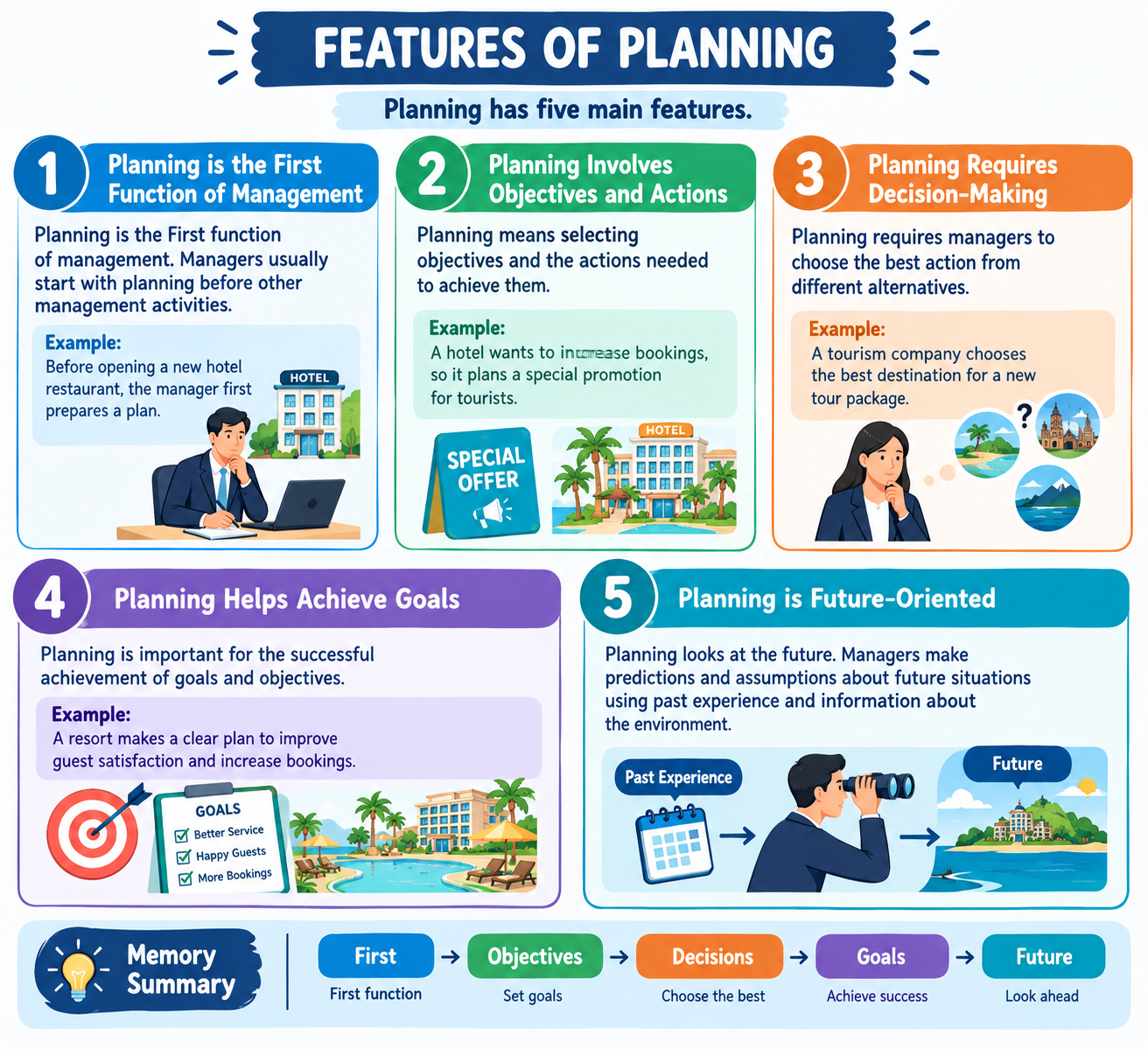
First Function of Management
Planning acts as the primary starting point for all managerial tasks before organizing, leading, or controlling.
Show Example
Example: A hotel manager makes a plan before opening a new restaurant.
Involves Goals and Actions
Identifies the intended results the business wants to achieve and sets the specific steps to reach them.
Show Example
Example: A hotel sets a goal to increase bookings and plans a promotion.
Requires Decision-Making
Involves evaluating multiple alternative courses of action and selecting the best path forward.
Show Example
Example: A tourism company chooses the best destination for a new tour.
Helps Achieve Goals
Guides collective effort systematically to turn intended targets into measurable achievements.
Show Example
Example: A resort plans activities to increase guest satisfaction.
Future-Oriented
Looks ahead by analyzing market forecasts and predicting coming trends before taking action.
Show Example
Example: A hotel predicts the number of tourists for the next holiday season.
💡 3. IMPORTANCE OF PLANNING
Why planning is critical for organizational success and performance excellence:
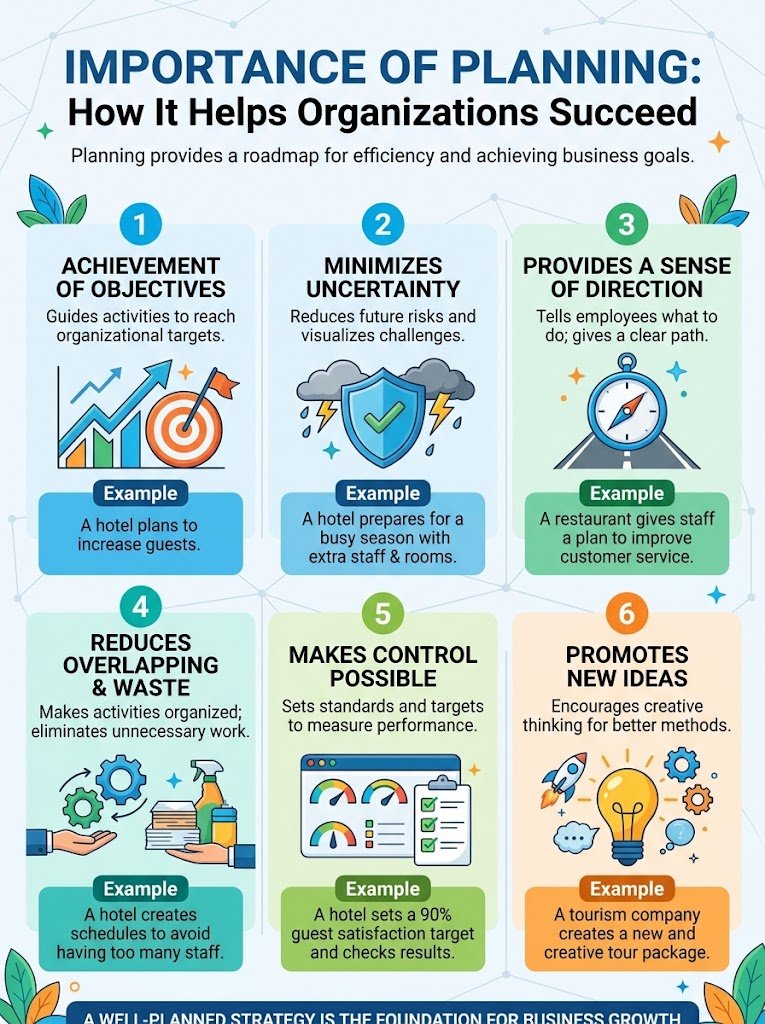
1. Helps Achieve Goals
Establishes clear targets and outlines the exact steps needed to reach business objectives successfully.
Example
A hotel makes a plan to increase room bookings.
2. Reduces Risks
Anticipates potential challenges and market downturns, allowing the business to prepare in advance.
Example
A hotel prepares for a possible decrease in tourists during the low season.
3. Saves Time and Money
Optimizes resource allocation and inventory management to prevent unnecessary expenses and waste.
Example
A restaurant plans how much food to buy to avoid waste.
4. Improves Decision-Making
Provides a systematic framework to analyze various alternatives and select the most effective solution.
Example
A tourism company compares different destinations before choosing a tour location.
5. Provides Direction
Clarifies expectations and standard operating guidelines so every employee works toward common goals.
Example
A hotel manager gives employees a clear plan for improving guest service.
6. Improves Coordination
Synchronizes tasks across different sections and teams to ensure seamless operational flow.
Example
The front office and housekeeping departments coordinate to prepare rooms for arriving guests.
📂 PART 2: TYPES OF PLANS
Organizations structure their planning hierarchy into four core categories:
- 1. Short-Term / Operational Plans
- 2. Medium-Term / Tactical Plans
- 3. Long-Term / Strategic Plans
- 4. Contingency / Emergency Plans
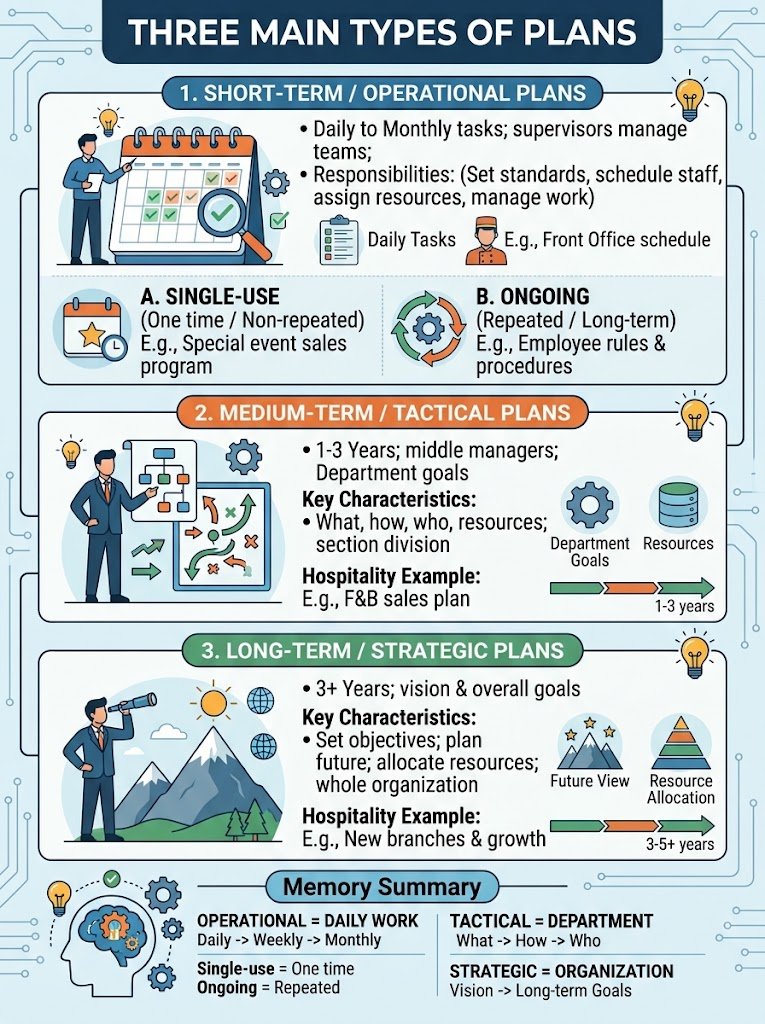
1. Short-Term / Operational Plans
Scope: Daily, Weekly, Monthly | Managed by First-Level SupervisorsShort-term plans for daily activities. Used to supervise direct day-to-day workflow, establish performance standards, and allocate team tasks across frontline operations.
Supervisors use operational plans to:
- Set standards
- Make schedules
- Arrange resources
- Manage daily work
- Report progress
Designed for non-recurring activities.
Example: A hotel holiday sales event or project budget.
Standing policies used repeatedly over long periods.
Example: Housekeeping room cleaning procedures and code of conduct.
2. Medium-Term / Tactical Plans
Scope: 1 to 3 Years | Managed by Middle ManagersPlans for specific departments. Translates broad corporate objectives into specific departmental goals, actionable campaigns, and structured resource allocations.
Tactical plans determine:
- Departmental duties
- Implementation methods
- Assigned responsibilities
- Required resources
- Task division across sections
3. Long-Term / Strategic Plans
Scope: 3+ to 5 Years | Managed by Top-Level ManagementLong-term plans for the whole organization. Rooted in the organization's overarching vision, mission, macro investments, and external market adaptation.
Strategic planning entails:
- Long-term goals
- Future expansions
- Capital resource allocation
- Whole organization focus
- Environmental change preparedness
4. Contingency Plans
Scope: As-Needed / Emergency | Prepared for Sudden CrisesPlans for unexpected problems (Plan B). Prepared in advance to ensure the business can respond swiftly and effectively whenever unplanned disruptions occur.
Contingency planning entails:
- Emergency protocols
- Backup power & IT systems
- Crisis communications
- Business continuity steps
- Risk response procedures
Strategic → Tactical → Operational → Contingency
🎯 FINAL REVIEW
Planning Fundamentals
PLANNING = DECIDE BEFORE ACTION
- First Function of Management
- What → How → Where → Who → Results
- Reduces uncertainty & gives direction
Types of Plans
OPERATIONAL → TACTICAL → STRATEGIC
- OPERATIONAL → DAILY (Supervisors)
- TACTICAL → DEPARTMENT (1–3 Yrs, Middle)
- STRATEGIC → FUTURE (3+ Yrs, Top Level)
Operational plans manage daily work, tactical plans manage departments, and strategic plans focus on the future of the whole organization.
🎮 Memory Challenge
📝 Comprehensive Quiz
1. What is the very first function of management?
💡 View Answer & Example
Answer: Planning.
Reason: Managers must plan before executing organizing, leading, or controlling.
2. Which plan covers 1 to 3 years and focuses on departments?
💡 View Answer & Example
Answer: Tactical (Medium-Term) Plans.
Example: A 2-year food and beverage sales boost program.
3. What is the key difference between single-use and ongoing plans?
💡 View Answer & Example
Answer: Single-use plans target non-repeating events (like a holiday event budget), while ongoing plans provide standing policies used repeatedly.
4. Who primarily formulates strategic plans?
💡 View Answer & Example
Answer: Top-Level Management.
Scope: Long-term (3+ years) considering the whole organization.