
Result
Leadership
Master the core fundamentals of Leadership, key definitions, management differences, essential skills, and leadership styles with clear color-coded explanations.
Audio Summary Podcast
Leadership is the ability to guide, influence, inspire, and motivate others to reach common goals.
1. Guide
2. Influence
3. Inspire
4. Motivate
Key Definitions & Practical Examples
Leadership is the ability to guide and help people.
Hospitality ExampleA hotel manager guides the hotel staff to give good service to guests.
Leadership is the ability to influence people to achieve a goal.
Tourism ExampleA tour leader motivates the tour team to make the trip successful.
Leadership means helping people work together to reach a goal.
Hospitality ExampleA restaurant supervisor helps the staff work together to serve customers quickly.
Leadership Formula
Leadership = Guide + Motivate + Goal
- Guide: help people know what to do.
- Motivate: encourage people to do their best.
- Goal: help the team achieve a target.
Very Easy Sentence
"A leader guides and motivates people to achieve a goal."
ExampleA hotel manager guides and motivates employees to give excellent service to guests.
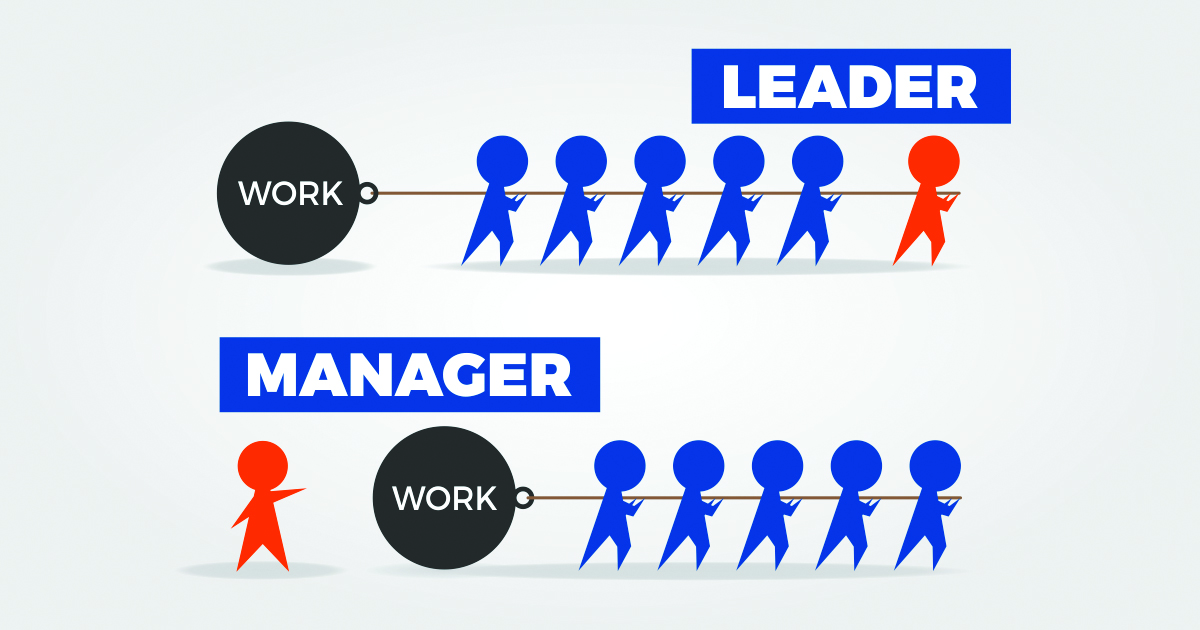
Management
Planning, organizing, and controlling work to achieve a goal.
(Giving Instructions and Orders)
👉 Focuses on the work, planning, and monitoring.
Leadership
Guiding and motivating people to achieve a goal.
👉 Focuses on people, motivation, and direction.
Easy Comparison Table
| Management (Work Focus) | Leadership (People Focus) |
|---|---|
| Manages the work | Leads the people |
| Plans the work | Guides people |
| Organizes work | Motivates people |
| Checks the work | Inspires people |
| Focuses on tasks | Focuses on people |
| Makes sure work is done | Helps people do their best |
Hospitality Example
| Management Actions | Leadership Actions |
|---|---|
| The hotel manager makes the staff schedule. | The hotel leader motivates the staff. |
| He checks the work. | He encourages the staff. |
| He organizes hotel activities. | He helps the team work together. |
Very Easy Example (Imagine a hotel):
Manager: “You work at reception from 8:00 to 4:00.”
👉 The manager plans and organizes the work.
Leader: “Good job! Keep helping our guests.”
👉 The leader motivates and guides the employees.
1. Ability to Inspire
Definition: A leader encourages the team to work toward a goal.
Restaurant ExampleA restaurant manager encourages employees to make the restaurant the best in the hotel.
2. Integrity & Honesty
Honesty: Tell the truth
Definition: A good leader tells the truth and does the right thing.
Hotel ExampleA hotel manager tells a guest about a mistake on the bill and corrects it.
3. Commitment
Definition: A leader works hard and leads by example.
Hotel ExampleA hotel manager helps reception staff during a busy tourist season.
4. Confidence
Definition: A leader stays calm and believes the team can solve problems.
Booking System ExampleA hotel booking system stops working. The manager stays calm and helps the staff solve the problem.
5. Communication
Definition: A leader gives clear information to the team.
Reception ExampleA hotel manager tells reception staff to check in each guest in less than five minutes.
6. Creativity
Definition: A leader finds new and better ways to do things.
Tourism ExampleA tour manager creates a new tour to help tourists enjoy local attractions.
Easy Summary for Memorization (Leadership Skills)
| Leadership Skill | Easy Meaning (Color-Coded) |
|---|---|
| Inspire | Encourage people |
| Integrity | Do the right thing |
| Honesty | Tell the truth |
| Commitment | Work hard |
| Confidence | Believe in yourself |
| Communication | Talk and listen clearly |
| Creativity | Think of new ideas |
One Easy Sentence to Remember:
"A good encourages, tells the truth, works hard, stays calm, communicates clearly, and thinks of new ideas." 🌟

1. Autocratic Leadership
Definition: The leader makes decisions alone and tells employees what to do.
- The leader makes decisions.
- Employees follow instructions.
- Employees have little say.
- Focuses on the work.
A hotel manager says, “All employees must go to the emergency area now.”
When useful: In emergencies when quick decisions are needed.
2. Democratic / Participative
Definition: The leader asks employees for ideas before making decisions.
- The leader listens to employees.
- Employees share ideas.
- The team discusses decisions.
- Employees feel valued.
A restaurant manager asks employees, “What food should we add to the menu?”
When useful: When the leader wants ideas and teamwork.
3. Free-rein / Delegative
Definition: The leader gives employees a task and lets them choose how to do it.
- Employees have freedom.
- Make decisions about work.
- More responsibility.
- Little supervision.
A hotel manager tells the marketing team, “Create a campaign to attract more tourists. Choose the best way.”
When useful: When employees are skilled and can work alone.
4. Situational Leadership
Changing leadership style to fit the situation, employees, and the task.
Core Definitions:
• Changing leadership style to fit the situation.
• Using different styles with different people and tasks.
• Choosing the best way to lead depending on employees and the task.
A hotel manager gives clear instructions to a new employee but gives an experienced employee more freedom.
1. Telling
Meaning: Tell what and how to do.
Example: Explaining to a new receptionist how to check in a guest.
Remember: Tell + Explain2. Selling / Coaching
Meaning: Explain, teach, and encourage.
Example: Training a new waiter to serve guests.
Remember: Teach + Encourage3. Participating
Meaning: Work with and share decisions.
Example: Working with reception team to solve a booking issue.
Remember: Work together4. Delegating
Meaning: Give responsibility & check progress.
Example: Allowing housekeeping manager to organize schedule.
Remember: Give responsibility5. Transformational Leadership
Inspiring people to improve, learn, and make positive organizational changes.
Core Definitions:
• Inspiring people to improve and make positive changes.
• Helping people and organizations transform.
• Motivating employees to learn, grow, and perform better.
A hotel manager motivates employees, trains them, and introduces new ideas to improve guest service.
1. Difficult Decisions
Meaning: Can make hard decisions.
Example: Retraining staff due to poor service.
Remember: Make hard decisions2. Adaptability
Meaning: Change & accept new ways.
Example: Using AI tech to improve guest service.
Remember: Accept change3. Willing to Listen
Meaning: Listen to new ideas.
Example: Listening to receptionist's idea to reduce waiting time.
Remember: Listen to ideas4. Proactive
Meaning: Take action early.
Example: Offering special packages before tourist season.
Remember: Act early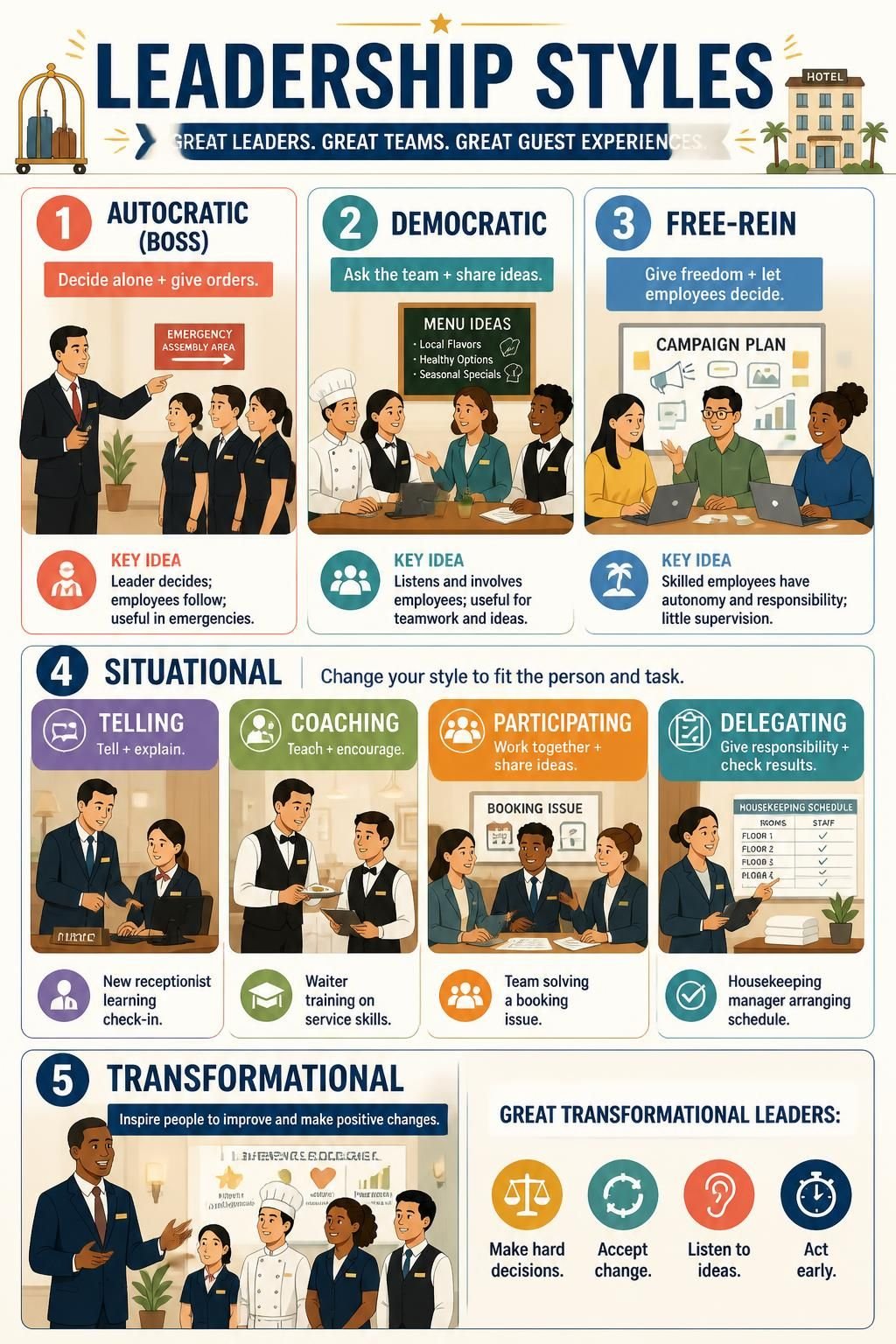
Leadership Styles Quick Reference Table
| Leadership Style | Easy Word | Simple Definition | Hospitality Example |
|---|---|---|---|
| 1. Autocratic | Boss | The leader decides alone. | A hotel manager tells staff what to do. |
| 2. Democratic | Together | The leader asks the team for ideas. | A restaurant manager asks staff for ideas. |
| 3. Free-rein | Freedom | The leader gives staff freedom to decide. | A hotel manager lets experienced staff organize their work. |
| 4. Situational | Change | The leader changes style for each situation. | A manager guides new staff but gives freedom to experienced staff. |
| 5. Transformational | Inspire | The leader motivates people to improve. | A hotel manager motivates staff to give excellent service. |
Easy Sentence for the Exam:
"A leader can decide alone, work together, give freedom, change the style, or inspire people." 🚀
1. What is the key difference between management and leadership?
💡 View Answer & Example
Answer: Management focuses on work, tasks, and planning, while leadership focuses on guiding and motivating people.
2. Which leadership style involves the leader making decisions alone without employee input?
💡 View Answer & Example
Answer: Autocratic Leadership.
Example: A manager giving direct emergency orders.
3. What does Free-rein leadership mean?
💡 View Answer & Example
Answer: Giving employees complete freedom and autonomy to decide how to perform tasks.
4. What is Transformational Leadership focused on?
💡 View Answer & Example
Answer: Inspiring people to improve, learn, and make positive organizational changes.
Styles Quick Formula
- Autocratic = Boss = Decide alone
- Democratic = Together = Ask the team
- Free-rein = Freedom = Let staff decide
- Situational = Change = Change the style
- Transformational = Inspire = Motivate people
Memory Tricks (I-H-C & A-D-F)
Leadership Skills (I – H – C – C – C – C):
I = Inspire | H = Honesty & Integrity | C = Commitment | C = Confidence | C = Communication | C = Creativity
Leadership Styles (A – D – F – S – T):
A = Autocratic | D = Democratic | F = Free-rein | S = Situational | T = Transformational
Important Points for the Exam
- Leadership: The ability to influence a group toward achieving goals.
- Management: The power or authority to give orders.
- Autocratic: The leader makes decisions without employee involvement.
- Democratic: Employees participate in decision-making.
- Free-rein: Employees have freedom to decide how to perform tasks.
- Situational: The leadership style changes according to people and tasks.
- Situational Styles: Telling, Selling/Coaching, Participating, and Delegating.
- Transformational: Positive change, motivation, confidence, and performance.
- Key Skills: Inspire, Honesty & Integrity, Commitment, Confidence, Communication, Creativity.
- Rule: No single leadership style is suitable for every situation.
The Golden Sentence
"Management manages the work, while leadership leads the people." 🌟